

Imagine you need to push a floating boat across a tank of water, but your hand must never touch the water. How could you do it? You might place a solid, flexible barrier just under the boat and push the barrier from underneath. The barrier moves the boat without ever getting the boat wet—or your hand wet. This is almost exactly how a diaphragm compressor works. It compresses gas without the mechanical parts ever touching the gas. The secret is a thin, flexible metal wall called a diaphragm, which acts like a perfect, impermeable barrier between the hydraulic oil (the “hand”) and the gas (the “boat”).
The Core Problem: Why Avoid Touching the Gas?
In many industrial processes—semiconductor manufacturing, pharmaceutical production, hydrogen refueling, and specialty gas handling—the gas must stay absolutely pure. If a compressor uses oil‑lubricated pistons or sliding seals, tiny amounts of oil, wear particles, or even moisture can leak into the gas stream. For ultra‑high‑purity gases (99.999% or purer) or for dangerous gases like hydrogen, silane, or hydrogen chloride, any contamination is unacceptable. A diaphragm compressor solves this by ensuring that no moving part ever makes contact with the gas.
The Simple Analogy: A Strong, Flexible Wall
Think of the diaphragm as a strong, flexible, metal wall that divides the compressor into two completely separate zones:
- One side (the “oily side”) contains hydraulic oil. This oil is pushed and pulled by a hydraulic piston.
- The other side (the “gas side”) contains the gas you want to compress. This side is sealed and never sees oil or mechanical friction.
When the hydraulic piston moves forward, it pushes oil against the diaphragm. The diaphragm flexes (bends) into the gas chamber, reducing the gas volume and raising its pressure. When the piston moves back, the diaphragm flexes back, drawing in fresh gas. Throughout the entire cycle, the diaphragm acts like a perfect barrier: the oil never touches the gas, and the gas never touches the oil or any moving mechanical part.
Why “Not Touching” Matters
Because the gas never contacts the hydraulic oil or the piston rings, a diaphragm compressor offers three unbeatable advantages:
- Zero Contamination – No oil, grease, or wear particles can enter the gas stream. This preserves the purity of expensive or sensitive gases.
- Zero Leakage – The static seals around the diaphragm are far more reliable than sliding seals. Dangerous or valuable gases stay inside the compressor.
- Zero Lubricant in the Gas Path—For applications like fuel cell hydrogen or medical gases, oil‑free compression is not a luxury; it is a requirement.
What Does the Diaphragm Touch?
If the diaphragm itself touches the gas, is that a problem? No, because the diaphragm is made from a compatible metal (stainless steel, nickel alloy, etc.) that does not react with the gas. The gas only touches the diaphragm and the inner walls of the gas head—both of which are machined to a very smooth, clean finish. So while the gas does touch the diaphragm, it never touches any lubricated or rubbing part. That is the key distinction: contact with a clean, static metal surface is safe; contact with oil or a wearing seal is not.
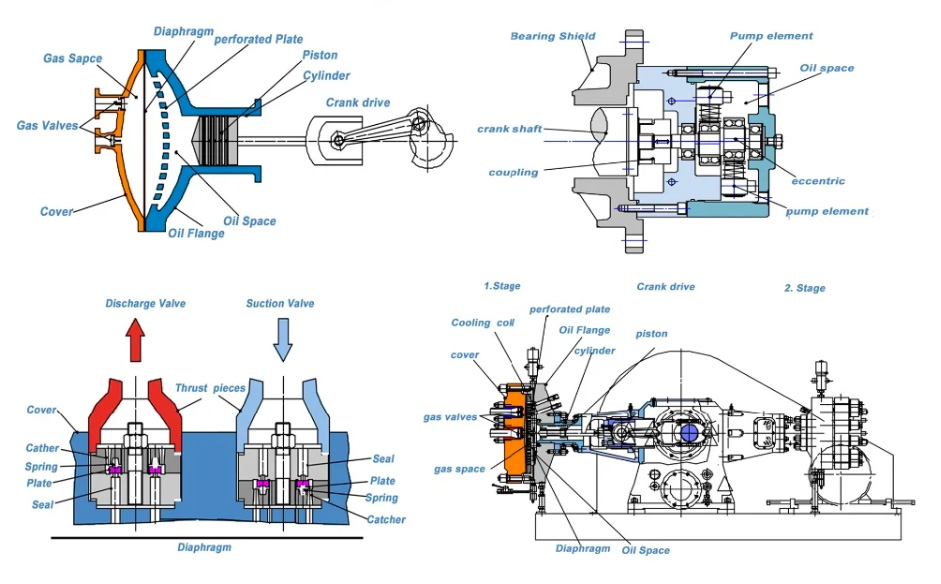
From Analogy to Real Machine
A real diaphragm compressor is more than just a diaphragm. It includes:
- A hydraulic system that precisely controls the oil pressure, ensuring the diaphragm bends evenly and lasts for millions of cycles.
- Gas valves that open and close at the right moments to let gas in and out.
- Cooling to manage the heat generated during compression (remember: compressing gas makes it hot, even without friction).
- Multiple stages for high‑pressure applications – a two‑stage diaphragm compressor uses two diaphragms in series, with cooling between them.
But the fundamental principle remains the same: the gas is pushed by a flexible wall, not by a piston that rubs against a cylinder.
Why This Matters for Your Application
If you are handling high‑purity hydrogen for a fuel cell, expensive helium for MRI machines, toxic silane for solar panels, or corrosive hydrogen chloride for chemical synthesis, you need compression that does not contaminate. A diaphragm compressor is the only technology that truly isolates the gas from all lubricants and sliding friction. It is the reason why diaphragm compressors are called the “cleanest” compressors in the world.
Xuzhou Huayan Gas Equipment Co., Ltd.: Engineering the Perfect Barrier
With 40 years of dedicated experience in diaphragm compressor design and manufacturing, Xuzhou Huayan has mastered the art of building these “invisible walls.” We know that a diaphragm must be precisely formed, heat‑treated, and clamped to survive millions of pressure cycles. We know which alloys resist hydrogen embrittlement and which surface finishes prevent particle generation.
Our Engineering Commitment to Contact‑Free Compression:
- In‑House Design and Manufacturing – We design and build every diaphragm, gas head, and hydraulic system ourselves. This gives us complete control over the quality of the barrier that separates oil from gas.
- Application‑Specific Materials – Depending on your gas (hydrogen, helium, silane, argon, etc.), we select the optimal diaphragm alloy and gas head finish. One material does not fit all.
- Custom Configurations—Need a single stage for low pressure or a four‑stage for 100 MPa? A vertical, horizontal, or V‑shape layout? We customize the whole machine to your space and performance needs.
- Decades of Proven Reliability – Our diaphragm compressors run in semiconductor fabs, hydrogen refueling stations, specialty gas plants, and research labs worldwide. Each one proves that compression without contact is not only possible—it is practical and durable.
Conclusion
A diaphragm compressor works like a strong, flexible wall that pushes gas without ever letting the driving oil touch the gas. No pistons sliding against cylinders, no oil-wetted seals rubbing on shafts—just a clean, static metal barrier that flexes billions of times. This is how ultra‑high purity and zero leakage are achieved.
If your application demands the cleanest, safest, most reliable gas compression, the diaphragm compressor is your answer. And with four decades of experience, Xuzhou Huayan is your partner to build it.
Contact our engineering team to discuss how a diaphragm compressor can solve your contamination‑sensitive gas compression needs.
Xuzhou Huayan Gas Equipment Co., Ltd.
Email: Mail@huayanmail.com
Phone: +86 19351565170
Engineering Clean Compression for Over 40 Years.
Post time: Apr-03-2026