

As the world accelerates toward clean energy, hydrogen has emerged as a cornerstone of the global energy transition. From powering fuel cell vehicles to enabling industrial decarbonization, hydrogen’s potential is immense. However, harnessing this potential presents a unique engineering challenge: hydrogen compression.
Hydrogen is the lightest and most reactive element on the periodic table. Its tiny molecules have a notorious tendency to escape through microscopic gaps, and its wide flammability range demands uncompromising safety standards. A hydrogen compressor is a specialized machine designed to safely and efficiently increase the pressure of hydrogen gas, enabling its storage, transportation, and utilization.
At Xuzhou Huayan Gas Equipment Co., Ltd., we have spent over 40 years mastering gas compression technology. Our expertise culminates in a product line ideally suited for the challenges of hydrogen: the diaphragm compressor. Trusted by clients worldwide, Huayan compressors are engineered to handle hydrogen with absolute purity, zero leakage, and unwavering reliability.
Why Hydrogen Compression is Different
Compressing hydrogen is not like compressing air or nitrogen. Several factors make it a uniquely demanding task:
- Molecular Size: Hydrogen molecules are exceptionally small, making them prone to leakage through conventional seals.
- Embrittlement: Hydrogen can cause embrittlement in certain metals, requiring careful material selection.
- Safety: With a wide flammability range and low ignition energy, hydrogen systems must be hermetically sealed to prevent any risk of explosion.
- Purity Requirements: In applications like fuel cells and semiconductor manufacturing, even trace amounts of oil contamination can destroy catalysts or ruin products.
For these reasons, not all compressors are suitable for hydrogen. While reciprocating piston compressors can be used, they often introduce oil contamination and face leakage challenges. The optimal solution for demanding hydrogen applications is the diaphragm compressor.
How a Diaphragm Hydrogen Compressor Works
A diaphragm compressor is a specialized variant of the reciprocating compressor, but with a critical distinction: the gas never contacts the lubricating oil or moving mechanical parts.
The Core Principle: Hydraulic Drive with a Hermetic Barrier
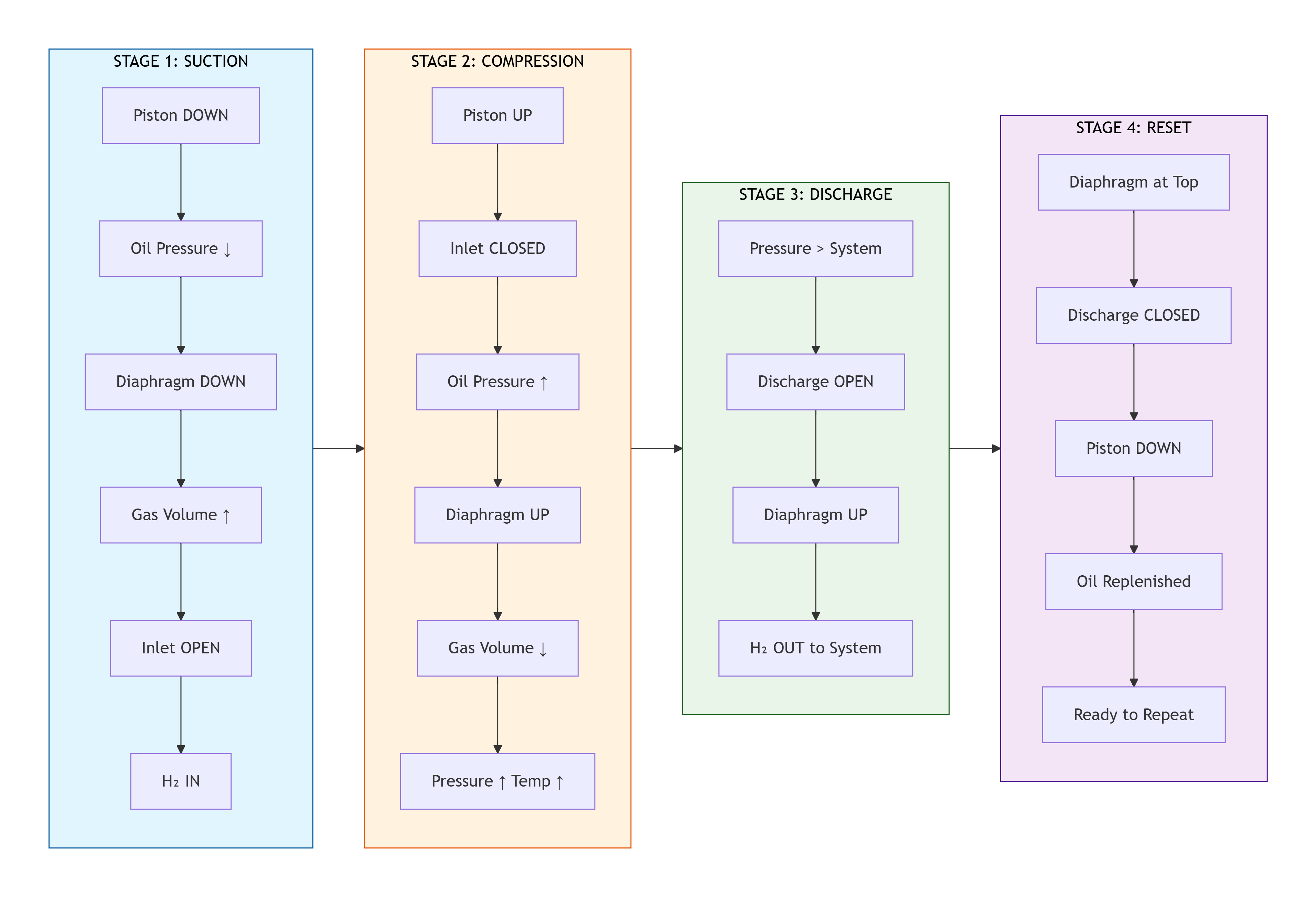
The compression of hydrogen occurs by means of a flexible metal membrane—the diaphragm—instead of a direct piston element. Here is a step-by-step breakdown of the hydrogen compression cycle:
1. Hydraulic Drive System
An electric motor drives a crankshaft, which is connected to a piston moving inside a cylinder filled with hydraulic oil. This piston does not touch the hydrogen; instead, it pressurizes the oil.
2. The Diaphragm Barrier
The hydraulic oil pushes against a stack of high-strength metal diaphragms. These diaphragms are clamped tightly between the hydraulic side and the gas side, creating a perfect, static seal. Only the diaphragms and the gas chamber come into contact with the hydrogen.
3. The Compression Cycle
- Suction Phase: The hydraulic piston moves downward, reducing oil pressure. The diaphragm flexes away from the gas head, creating a vacuum in the gas chamber. The inlet valve opens, and hydrogen is drawn into the chamber.
- Compression Phase: The piston moves upward, pressurizing the oil. The diaphragm flexes into the gas chamber, reducing its volume. Both valves are now closed, and the hydrogen is trapped and compressed.
- Discharge Phase: When gas pressure exceeds the discharge line pressure, the discharge valve opens. The diaphragm continues its stroke, sweeping the contoured cavity and pushing high-pressure hydrogen out to the system.
- Reset Phase: The piston begins its descent, the diaphragm relaxes, and the cycle repeats. A small compensating pump ensures hydraulic fluid volume is maintained.
This elegant design ensures that hydrogen is compressed without ever being contaminated or escaping to the atmosphere.
Why Choose a Huayan Diaphragm Compressor for Hydrogen?
With four decades of manufacturing experience, Xuzhou Huayan Gas Equipment Co., Ltd. has refined the diaphragm compressor to meet the most stringent demands of the hydrogen economy. Here is why our compressors are the superior choice:
1. Absolute Gas Purity (100% Oil-Free)
The hermetically sealed design guarantees that hydrogen never contacts lubricating oil. This is essential for:
- Fuel Cell Applications: Oil contamination can permanently damage fuel cell stacks.
- Electronics Manufacturing: High-purity hydrogen is required for semiconductor processes.
- Laboratory & Research: Experiments demand uncontaminated gas.
2. Zero Leakage for Maximum Safety
Hydrogen’s small molecules are challenging to contain. Our diaphragm compressors use only static seals—there are no dynamic piston rings or packings that can wear and leak. This ensures:
- No escape of flammable gas
- No loss of valuable product
- Compliance with the strictest safety codes for hazardous areas
3. High-Pressure Capability
Modern hydrogen applications, particularly vehicle refueling, require extremely high pressures (35 MPa / 350 bar to 70 MPa / 700 bar or more). Diaphragm compressors are inherently suited for high-pressure ratios and can achieve discharge pressures up to 100 MPa (1000 bar) with multi-stage designs. Our GZ, GL, GV, and GD series are engineered to meet these demanding specifications.
4. Handling Hydrogen’s Unique Properties
The metal diaphragm acts as a perfect barrier, preventing hydrogen embrittlement of moving parts and ensuring long-term mechanical integrity. The design also accommodates the heat of compression safely.
5. Low Maintenance and High Reliability
With no contact between the gas and moving parts, wear is minimized. The primary wear component—the diaphragm—is designed for long life (typically thousands of operating hours). Maintenance is straightforward, reducing downtime and operational costs.
6. Decades of Specialized Experience
With 40 years in the industry, our technical team possesses deep knowledge in metallurgy, hydraulics, and thermodynamics. We understand the nuances of hydrogen compression and apply this expertise to every machine we build.
7. Fully Customized Solutions
No two hydrogen projects are identical. We offer customized design and manufacturing to match your exact requirements:
- Specific inlet and outlet pressures
- Tailored flow rates
- Materials compatible with your gas composition
- Multi-stage configurations for high compression ratios
- Skid-mounted packages for easy installation
Applications of Huayan Hydrogen Compressors
Our diaphragm compressors are deployed across the hydrogen value chain:
| Application Area | Typical Use | Pressure Range |
|---|---|---|
| Hydrogen Refueling Stations (HRS) | Compressing H₂ for fuel cell vehicles | 35-70 MPa (350-700 bar) |
| Electrolyzer Systems | Boosting output pressure for storage | 1 – 30 MPa |
| Industrial Gas Filling | Filling high-pressure cylinders | 15 – 30 MPa |
| Chemical Processing | Feeding hydrogen into reactors | 2 – 20 MPa |
| Electronics Industry | Ultra-pure H₂ for semiconductor manufacturing | 1 – 10 MPa |
| Laboratory & R&D | Precise, clean compression for experiments | Variable |
| Energy Storage | Compressing H₂ for grid-scale storage | 10 – 50 MPa |
Conclusion: Trust the Experts
As the world moves toward a hydrogen future, the integrity of your compression equipment is paramount. You need a solution that guarantees purity, ensures safety, and delivers reliable performance day after day.
For over 40 years, Xuzhou Huayan Gas Equipment Co., Ltd. has been a trusted name in gas compression. Our diaphragm compressors represent the gold standard for handling hydrogen—the fuel of tomorrow.
Do not compromise on safety or purity. Let our experience work for you.
Contact Us Today
Ready to discuss your hydrogen compression project? Contact our engineering team for a consultation.
- Email: Mail@huayanmail.com
- Phone: +8619351565170
Partner with Huayan—where 40 years of expertise meets the future of energy.
Post time: Feb-27-2026