

In industries where gas purity is paramount—semiconductor manufacturing, pharmaceutical production, hydrogen fuel cells, and specialty gas handling—even a microscopic speck of oil or a trace of wear debris can ruin an entire batch of products or damage sensitive equipment. The concept of a “zero‑contamination” compressor is not a marketing exaggeration; it is an engineering necessity. But what does zero contamination really mean, and how can a compressor achieve it? The answer lies in understanding how different compressor designs interact with the gas they compress—and why the diaphragm compressor has become the gold standard for purity-critical applications.
What Does “Zero Contamination” Mean in Gas Compression?
Zero contamination means that the gas exiting the compressor is identical in purity to the gas entering it. No oil mist, no hydrocarbon vapors, no microscopic metal or polymer particles, no moisture from lubricants, and no external air ingress. For ultra‑high‑purity applications, acceptable contamination levels are measured in parts per billion (ppb) or even parts per trillion (ppt). Achieving this requires a compressor that never introduces anything foreign into the gas stream.
Where Does Contamination Normally Come From?
In traditional compressor designs, contamination originates from two main sources:
- Lubricants: Oil‑lubricated compressers inevitably release tiny amounts of oil into the gas stream, either as vapor, mist, or liquid carryover. Even with sophisticated separators, trace hydrocarbons remain.
- Wear particles: Any compressor that relies on sliding contact—piston rings sliding against cylinder walls, vanes sliding in slots, or seals rubbing on shafts—generates microscopic wear debris. These particles become entrained in the gas, contaminating downstream processes.
Even so‑called “oil‑free” piston compressors still use non‑lubricated polymer rings that slide against the cylinder wall. The friction generates fine polymer dust, which is still a contaminant for many sensitive applications.
The Diaphragm Compressor: A True Zero‑Contamination Design
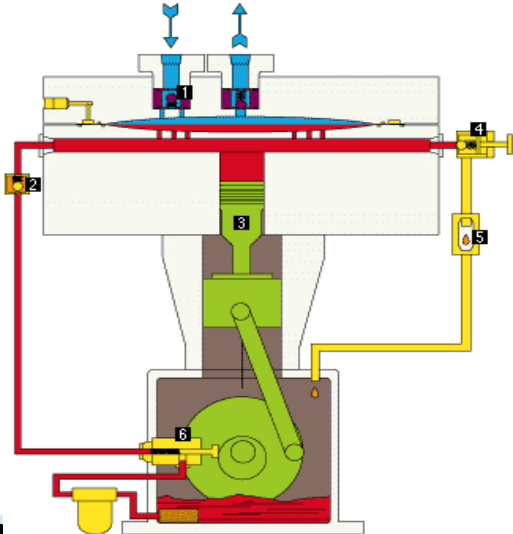
The diaphragm compressor operates on a completely different principle. Instead of a piston or rotor coming into contact with the gas, a flexible metal diaphragm—actuated by hydraulic oil—does the work of compression. The gas is contained in a sealed chamber on one side of the diaphragm, while the hydraulic system sits on the other side. The diaphragm forms an impenetrable barrier.
Because there is no sliding contact in the gas path, there are no wear particles. Because the hydraulic oil never touches the gas, there is no oil contamination. The gas only contacts the smooth, chemically compatible surfaces of the diaphragm and the gas head. This is why the diaphragm compressor is often called a “zero‑contamination” compressor.
How the Diaphragm Compressor Safeguards Gas Purity
1. Absolute Separation of Oil and Gas
The metal diaphragm is the ultimate barrier. Hydraulic oil drives the diaphragm from behind, but it never enters the gas chamber. There are no piston rings, seals, or packings in contact with the gas. This means no oil mist, no oil vapor, and no risk of hydrocarbon contamination—even at high pressures or after years of operation.
2. No Wear Particles in the Gas Stream
In a diaphragm compressor, the only moving part that touches the gas is the diaphragm itself. The diaphragm flexes without rubbing against any other surface. There is no sliding friction, so no microscopic particles are generated. This is fundamentally different from piston compressors, where the piston rings wear against the cylinder wall, creating polymer or metal dust.
3. Hermetic Sealing Against External Contamination
Diaphragm compressors are designed with static seals—gaskets and clamped diaphragm perimeters—rather than dynamic seals that rely on sliding contact. Static seals are far more reliable and prevent atmospheric moisture, oxygen, or dust from entering the gas stream. This is critical for moisture‑sensitive gases or processes requiring an inert atmosphere.
4. Clean, Compatible Materials
All gas-wetted surfaces—the diaphragm, the gas head, and the valves—are manufactured from materials chosen for their compatibility with the specific gas. Stainless steels, nickel alloys, and special coatings ensure no chemical reaction or outgassing. Smooth surface finishes (such as electropolishing) further reduce the risk of particle adhesion and make cleaning easy.
Why Gas Purity Matters: Real‑World Consequences
- Semiconductor manufacturing: A single hydrocarbon molecule on a silicon wafer can cause a defect that renders a microchip useless. Diaphragm compressors are standard in gas delivery systems for epitaxy, etching, and deposition.
- Hydrogen fuel cells: Fuel cell membranes are poisoned by traces of oil or sulfur. Diaphragm compressors deliver the ultra‑pure hydrogen required for long membrane life and high efficiency.
- Pharmaceutical production: Contaminated process gases can ruin an entire batch of medicines. Diaphragm compressors provide the sterile, oil‑free air and gas needed for critical operations.
- Specialty gas blending: Calibration gases and electronic gases must maintain precise compositions. Any contamination from the compressor alters the mixture, invalidating the product.
What to Look for in a Zero‑Contamination Compressor
When selecting a compressor for purity-critical applications, consider the following:
- Does the gas path contain any lubricated or sliding parts?
- Are the wetted materials compatible and corrosion‑resistant?
- Can the compressor be purged and cleaned effectively?
- Is there a risk of oil migration or particle generation over time?
The diaphragm compressor answers all these questions with a clear “no contamination.”
Xuzhou Huayan: 40 Years of Engineering Purity
At Xuzhou Huayan Gas Equipment Co., Ltd., we have been designing and manufacturing diaphragm compressors for four decades. We understand that “zero contamination” is not a slogan—it is a promise backed by rigorous engineering.
Our Commitment to Gas Purity:
- In‑house design and manufacturing – We control every detail, from diaphragm material selection to final assembly in a clean environment. This ensures that no contaminants are introduced during production.
- Customized for your gas—Whether you need to handle hydrogen, helium, argon, silane, or any other sensitive gas, we tailor the diaphragm alloy, head surface finish, and valve design to your exact requirements.
- Proven purity performance – Our diaphragm compressors are trusted by semiconductor fabs, hydrogen refueling stations, and specialty gas companies worldwide. They consistently deliver gas purity at the parts‑per‑billion level.
- Long‑term reliability – A pure compressor must also be a reliable one. Our designs minimize wear, extend diaphragm life, and reduce maintenance, ensuring that your process stays clean and online for years.
Conclusion
A “zero‑contamination” compressor is not a myth—it is a diaphragm compressor. By eliminating sliding contact, sealing oil away from the gas, and using only compatible, smooth materials, the diaphragm compressor safeguards gas purity better than any other technology. If your process cannot tolerate oil, particles, or moisture, the diaphragm compressor is not just an option; it is the only responsible choice.
For over 40 years, Xuzhou Huayan has been building diaphragm compressors that deliver uncompromising purity. Let us help you protect your most valuable gases.
Contact our engineering team to discuss how our zero‑contamination diaphragm compressors can meet your gas purity requirements.
Xuzhou Huayan Gas Equipment Co., Ltd.
Email: Mail@huayanmail.com
Phone: +86 19351565170
Engineering Purity for Over 40 Years.
Post time: Apr-24-2026