

Helium is among the most expensive and difficult gases to handle in modern industry. Its molecules are small, its density is low, and it escapes through seals that would hold almost any other gas. When you compress helium, two failures cost you the most: contamination that ruins its purity, and leakage that wastes an increasingly scarce, high-value resource.
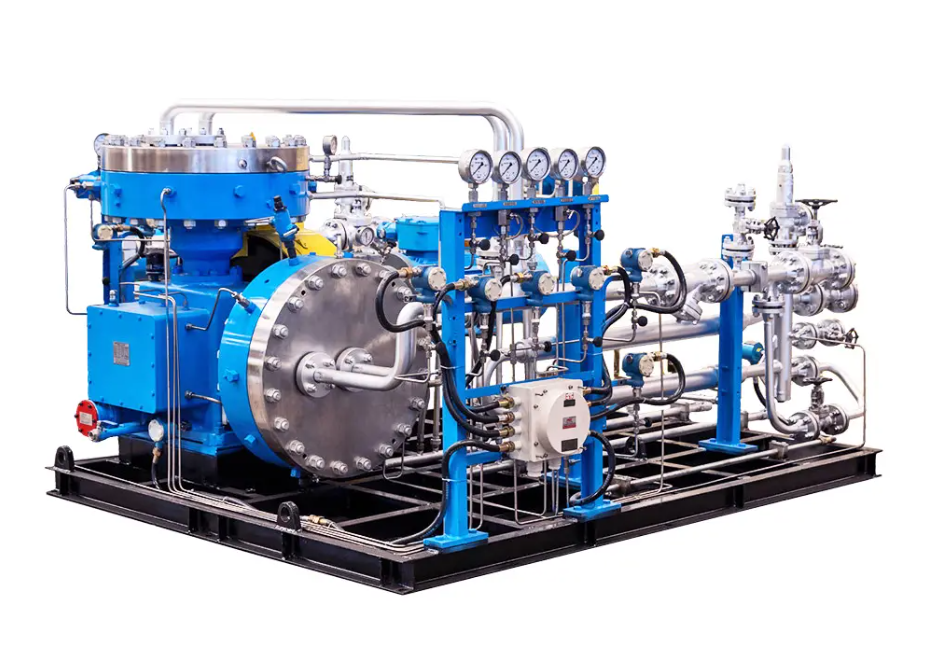
A diaphragm compressor built specifically for helium duty addresses both problems at the source. Rather than adding filters and separators to clean up a contaminated stream, it uses a physical metal barrier that keeps the gas completely isolated from lubricants. This article explains why helium is so hard to compress, how diaphragm isolation works, and what to look for when choosing a helium compressor for your facility.
Why Helium Compression Is So Demanding
Helium presents a set of challenges that ordinary compressor designs struggle to meet.
Purity matters commercially. Ultra-high-purity helium is used in semiconductor fabrication, fiber-optic manufacturing, medical imaging (MRI systems), aerospace testing, and leak-detection applications. Trace oil or moisture at the outlet can invalidate an entire production batch or compromise a scientific experiment. For many buyers, the value of the helium itself depends entirely on the purity they can guarantee.
The gas is easy to lose. Because helium molecules are tiny and light, they migrate through worn shaft seals, piston rings, and gaskets that would contain heavier gases without issue. Every leak is money leaving the system. In helium recovery and recycling loops, even a small fugitive loss accumulates into a substantial operating cost over time.
The operating conditions are severe. Helium service often means high pressure — for cylinder filling, transport, and storage — combined with the need to protect the gas from every source of contamination along the compression path.
Conventional oil-lubricated piston compressors place the lubricant close to the gas stream. Oil carryover, seal wear, and leakage paths can leave the gas dirtier and thinner than it entered. That is precisely the problem a diaphragm compressor is engineered to solve.
The Diaphragm Principle: A Solid Wall Between Gas and Oil
A diaphragm compressor is a positive displacement machine with one defining characteristic: a flexible, hydraulically actuated metal diaphragm forms a complete, leak-proof barrier between your process gas and the lubricated crankcase and piston.
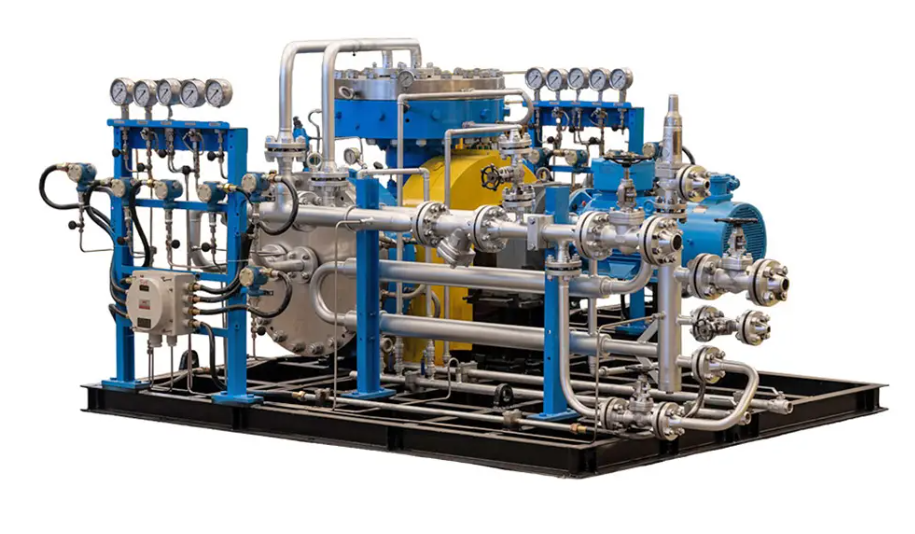
The machine is split into two sealed zones. On one side, a piston drives hydraulic oil. On the other side, your helium stays fully contained. When the piston advances, it pushes the oil against the diaphragm, which bends into the gas chamber, shrinks the gas volume, and raises its pressure. When the piston retracts, the diaphragm draws in fresh gas. The oil never crosses the barrier, and the gas never touches a lubricant.
The result is three guarantees in a single design:
- · Zero lubricant contact — your compressed helium remains oil-free, so purity is preserved from inlet to outlet.
- · Zero leakage — the hermetic seal minimizes fugitive emissions, protecting both the environment and your expensive helium.
- · Stable, unchanged gas — the gas stream is neither contaminated nor altered during compression.
For helium, this matters more than for almost any other gas. Oil-free operation protects its commercial purity, while the near-leak-free design protects its commercial value.
The G110L High-Purity Oil-Free Diaphragm Compressor
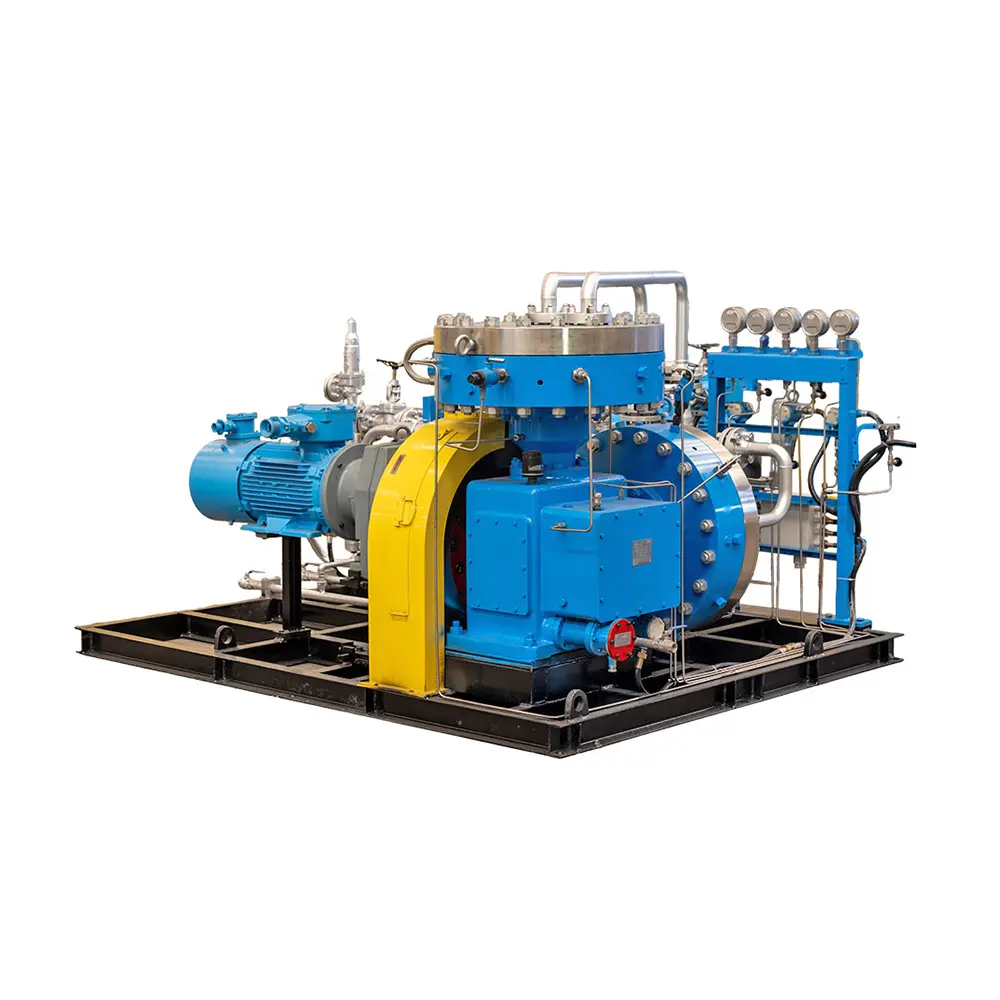
Xuzhou Huayan Gas Equipment Co., Ltd. builds the G110L platform to deliver these guarantees in demanding helium, oxygen, and hydrogen service. Key parameters include:
| Parameter | Specification |
| Maximum discharge pressure (design) | Up to 100 MPa (design capability; field-proven up to 87 MPa for hydrogen and 50 MPa for nitrogen) |
| Flow range | 10–200 Nm³/h per unit (at 0°C and 1 atm); higher flow to ~1000 Nm³/h via multi-unit parallel for low-pressure duty |
| Piston stroke | 110 mm–130 mm |
| Motor power | 7.5 kW–90 kW |
| Cooling | Water-cooled cylinder head with external cooler (standard) |
| Materials | Inconel 718 as the standard diaphragm material for hydrogen and high-pressure duty; other materials selected per gas application (including application-matched stainless steel and PTFE) |
Several design details protect purity and safety under real operating conditions:
A triple-layer diaphragm with rupture alarm. A process-side layer, a middle monitoring layer, and a hydraulic-side layer are assembled with micro-grooves that form a leak-detection channel connected to a pressure transducer. If the process-side layer ever fatigues and gas begins to migrate, the system triggers an automatic shutdown while the outer layer continues to block leakage.
Hermetic sealing and thermal control. An embedded double O-ring design seals the head more tightly than an open membrane head. The water-cooled cylinder head keeps gas temperature controlled, protecting both diaphragm and valve life during sustained helium duty.
Continuous safety monitoring. Cooling-water flow, oil pressure, and stage pressures and temperatures are monitored in real time with alarm and shutdown logic. A fixed gas detector on the skid monitors ambient concentration and interlocks with ventilation.
Because the cylinders require no lubrication, the G110L handles helium with the oil-free, leak-minimized performance that high-purity applications demand. Product-family claims for this diaphragm design cite gas purity of 99.9% with zero oil-contamination risk; buyers should verify the exact figure against the specific model configuration.
Real Installations: Where Purity-Critical Compression Proves Itself
Experience is the strongest evidence of reliability. Huayan diaphragm compressors are in service in some of the most demanding applications across the globe.
- · Hydrogen refueling: A diaphragm compressor at a hydrogen refueling station in Southeast Asia operates at 450 bar and achieves 99.999% hydrogen purity, serving more than 100 vehicles per day.
- · Laboratory and research: Oil-free diaphragm machines deliver ultra-high-pressure gases for spectroscopy and high-pressure simulation chambers, where sample purity directly determines data quality.
- · Medical gas systems: Oil-free units comply with governing standards for oxygen networks and hyperbaric chambers, protecting patient safety.
The same isolation that keeps helium clean in these settings is what makes the G110L a trusted choice for helium recovery, cylinder filling, and specialty-gas distribution.
Why Xuzhou Huayan — Expertise You Can Verify
Behind the G110L is a manufacturer with the depth to support a serious helium project:

- · Nearly 40 years of diaphragm compressor experience, building machines since 1985 within a cooperative factory covering 91,260m².
- · A technical team of 120 professionals supported by advanced CNC machining and rigorous quality control.
- · A global footprint across more than 50 countries on five continents, with over 500 active clients.
- · An annual production capacity of 500 gas compressor units.
Certifications and standards. The company holds ISO 9001:2015, CE, and CNEx explosion-proof certifications, and pressure-containing components can be supplied to ASME code upon request. Design and manufacturing follow recognized mechanical and pressure-equipment standards, with application-specific references for hydrogen and oxygen systems. This certification set opens the door to European, North American, and Middle Eastern projects.
Verifiable quality control. Factory tests are conducted in accordance with JB/T 6905, including a 48-hour continuous run at 5% over-pressure to verify safety margins. Performance parameters are verified through separate multi-stage operational tests. For leak-free duty, helium mass spectrometer leak detection is performed, with factory reports detailing the test pressure, holding time, and acceptance limit (e.g., a leak rate ≤ 1×10⁻⁶ Pa·m³/s). Customers may witness the performance and running data, with a witnessed factory report tied to the serial number and marked drawing — Huayan supports that level of verification.
Transparent operating boundaries. Honest suppliers tell you the limits too. Diaphragm plates and gas valves are consumable wear parts, with a typical service life of no less than 2,000 operating hours depending on gas composition, pressure ratio, and temperature. Budget for planned maintenance windows. And while a diaphragm compressor is ideal for high-purity, moderate-flow, high-pressure-ratio work, very large-volume low-pressure compression may be better served by conventional piston machines. Huayan will recommend the right configuration rather than overselling one.
Choosing a Helium Compressor: What to Verify
When you evaluate a helium compressor, confirm the following with the supplier:
1. Purity guarantee — the rated oil-free / contamination performance and how it is tested.
2. Leak-free duty — the tested boundary, test gas, pressure, method, instrument sensitivity, acceptance limit, and alarm proof.
3. Material compatibility — materials selected for your specific gas and operating envelope.
4. Certifications — ISO, CE, explosion-proof, and pressure-vessel credentials relevant to your market.
5. Reference installations — ask for comparable helium or high-purity-gas installations you can inspect.
Conclusion
Helium compression is not a place to compromise on design. Contamination destroys its value, and leakage wastes it. The G110L oil-free diaphragm compressor solves both problems with a physical metal barrier — zero lubricant contact, zero leakage, and stable gas purity — backed by nearly four decades of manufacturing expertise, verifiable testing, and global support.
Post time: Nov-13-2026